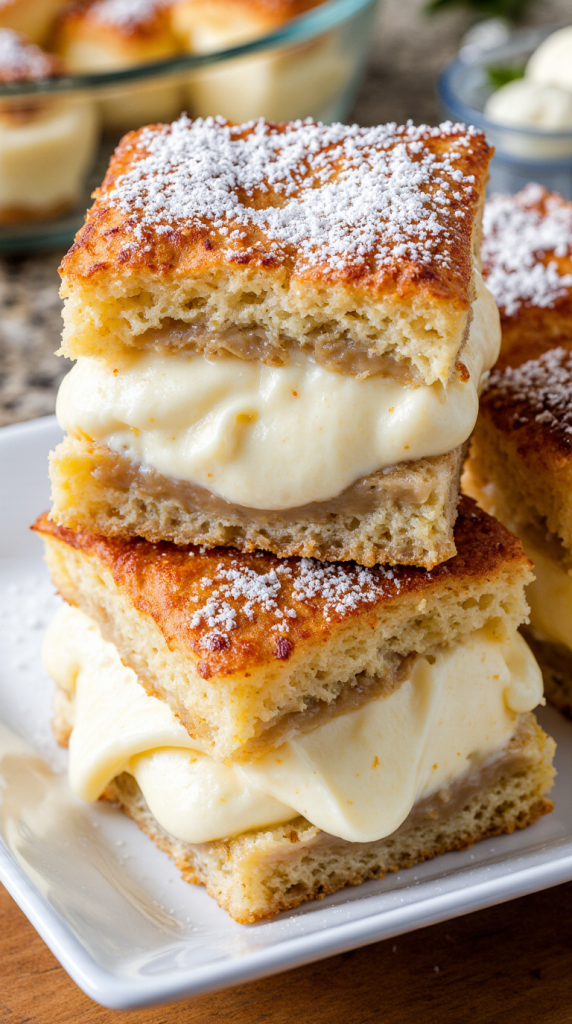
Banana Cream Pie Bars
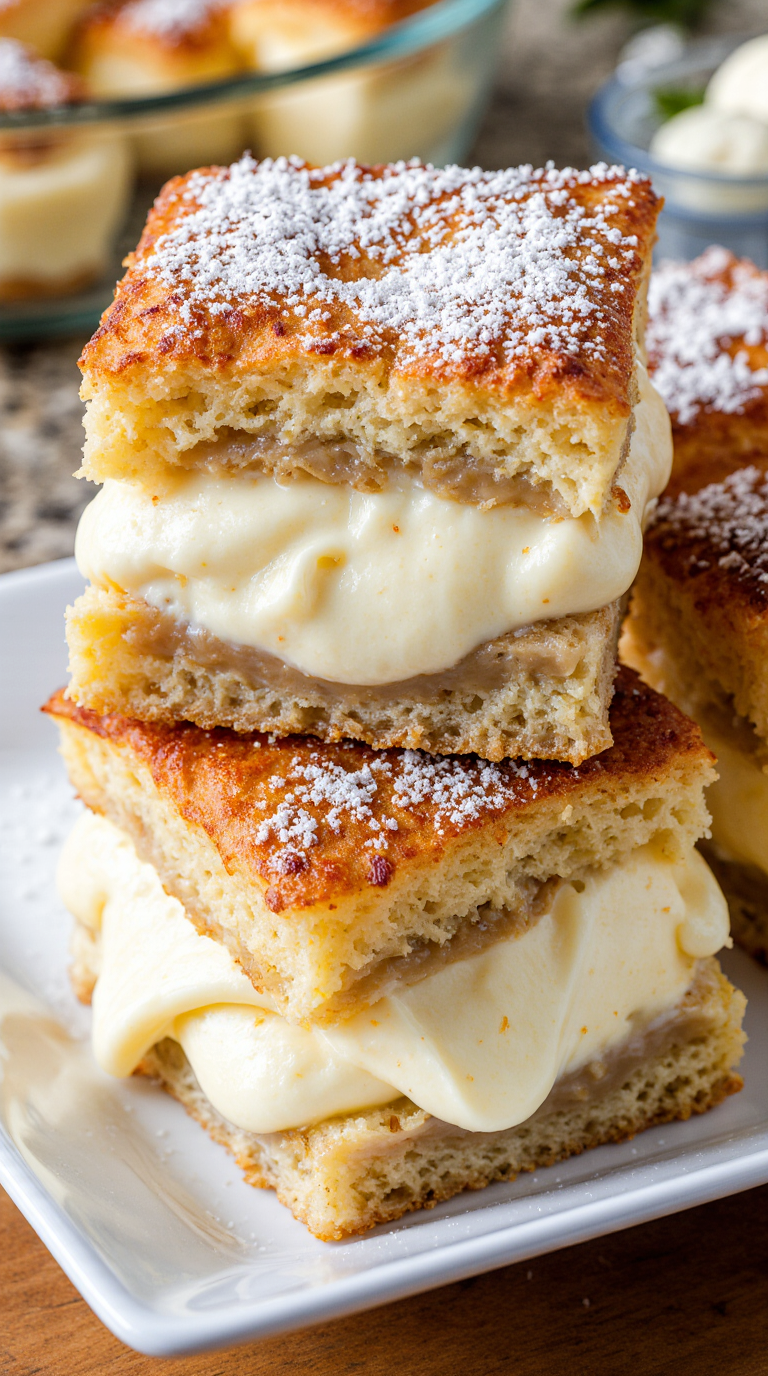
Banana Cream Pie Bars
These banana cream pie bars transform classic pie into portable, layered dessert bars with structural integrity. The method focuses on a vanilla wafer crust that stays crisp under moist layers, banana cake with precise moisture balance to support toppings, professional pastry cream that sets without becoming rubbery, and banana preservation techniques that prevent browning. Each component is calibrated to create bars that hold their shape when cut while delivering the creamy, banana-forward flavor of traditional cream pie.
Why this recipe works
Structural engineering through layers. Each component serves both flavor and functional purposes. The vanilla wafer crust provides a sturdy, neutral base that stays crisp despite moist toppings. The banana cake layer acts as a moisture-regulating sponge—dense enough to support weight but tender enough to eat easily. The pastry cream is calibrated to set firmly without becoming rubbery, creating clean layers when cut. The fresh bananas are strategically placed and treated to prevent sogginess and browning.
Moisture balance mathematics. The banana cake uses very ripe bananas for maximum flavor but includes buttermilk to control overall moisture content. This prevents the cake from becoming too wet and compromising the crust. The pastry cream thickness is precisely calculated—thick enough to hold layers but fluid enough to spread smoothly. The whipped cream topping is stabilized with just enough sugar to maintain structure without making the dessert overly sweet.
Temperature-controlled assembly. Each component must reach the proper temperature before assembly. The cake must be completely cool to prevent the pastry cream from melting. The pastry cream should be chilled but not ice-cold for easy spreading. The bananas are added just before final assembly to minimize oxidation. This temperature discipline ensures distinct layers and optimal texture in every bite.
Flavor layering strategy. The vanilla wafer crust provides subtle vanilla notes without competing with the banana. The cake layer delivers concentrated banana flavor through very ripe fruit. The pastry cream offers creamy vanilla contrast. The fresh banana slices provide bright, fresh fruit flavor and textural variation. The whipped cream topping adds lightness and visual appeal. Each layer complements rather than overwhelms the others.
Cutting science. The chilling time allows all components to set together, creating bars that hold their shape when cut. The parchment paper overhang enables clean removal from the pan. The hot knife technique ensures professional-looking cuts without dragging layers. These bars are designed to look as good as they taste, with clean edges and distinct layers visible in each serving.
Ingredients (cups & tablespoons only)
Crust & Cake
- 2 cupsvanilla wafer crumbs
- 1/4 cupgranulated sugar
- 1/2 cupunsalted butter, melted
- 1 1/2 cupsall-purpose flour
- 1 tspbaking powder
- 1/2 tspbaking soda
- 1/4 tspsalt
- 1/2 cupunsalted butter, room temp
- 3/4 cupgranulated sugar
- 2large eggs
- 1 tspvanilla extract
- 3very ripe bananas, mashed
- 1/4 cupbuttermilk
Fillings & Topping
- 2 cupswhole milk
- 1/2 cupgranulated sugar
- 1/4 cupcornstarch
- 4large egg yolks
- 2 tbspunsalted butter
- 1 tspvanilla extract
- 1/8 tspsalt
- 3-4ripe but firm bananas
- 2 tbsplemon juice
- 1 1/2 cupsheavy cream, cold
- 1/4 cuppowdered sugar
- 1/2 tspvanilla extract
Recipe
- Prepare pan: Preheat oven to 350°F. Line 9×13 inch baking pan with parchment paper, leaving 2-inch overhang on two sides for easy removal. Grease exposed pan sides lightly.
- Make crust: In medium bowl, combine vanilla wafer crumbs and 1/4 cup sugar. Add melted butter and mix until all crumbs are moistened and mixture resembles wet sand.
- Bake crust: Press crumb mixture firmly and evenly into prepared pan. Use flat-bottomed glass or measuring cup for even pressure. Bake 10 minutes until lightly golden and set. Cool while preparing cake layer.
- Mix dry ingredients: In medium bowl, whisk together flour, baking powder, baking soda, and salt. Set aside.
- Cream butter and sugar: In large bowl, beat room temperature butter and 3/4 cup sugar on medium-high until light and fluffy, about 2-3 minutes. Scrape bowl thoroughly.
- Add wet ingredients: Beat in eggs one at a time, then vanilla extract. Add mashed bananas and buttermilk; mix until combined (mixture may look curdled—this is normal).
- Combine mixtures: Add dry ingredients to wet ingredients. Mix on low just until combined. Do not overmix—small flour streaks are acceptable.
- Bake cake: Spread batter evenly over cooled crust. Bake 25-30 minutes until golden brown and toothpick inserted in center comes out clean. Cool completely in pan on wire rack.
- Make pastry cream: While cake cools, heat milk in saucepan until steaming but not boiling. In separate bowl, whisk together 1/2 cup sugar and cornstarch. Add egg yolks and whisk until smooth and pale.
- Temper eggs: Slowly pour about 1 cup hot milk into egg mixture while whisking constantly. This prevents curdling. Pour tempered mixture back into saucepan with remaining milk.
- Cook pastry cream: Cook over medium heat, whisking constantly, until mixture thickens and boils. Boil 1 minute, still whisking. Remove from heat.
- Finish pastry cream: Stir in butter, vanilla, and salt until smooth. Press plastic wrap directly on surface to prevent skin formation. Chill until cold, at least 2 hours.
- Prepare bananas: Slice remaining bananas into 1/4-inch rounds. Toss with lemon juice to prevent browning. Drain slightly before using.
- Assemble layers: Spread chilled pastry cream evenly over completely cooled cake. Arrange banana slices in single layer over pastry cream.
- Add topping: In chilled bowl, whip heavy cream, powdered sugar, and vanilla to stiff peaks. Spread evenly over banana layer.
- Chill and serve: Refrigerate at least 4 hours, preferably overnight. Use parchment overhang to lift bars from pan. Cut with hot knife into 16 bars. Serve chilled.
The cake layer will be thinner than standard banana cake—this is intentional to maintain proper layer proportions. The crust provides additional height and structure.
Crust structure & pressing techniques
Crumb selection
Vanilla wafers provide neutral flavor that complements without competing. Their fine crumb creates dense, compact crust that withstands moist layers. Graham crackers can be substituted but will change flavor profile significantly.
Pressing methods
Use flat-bottomed glass or measuring cup for even pressure. Press firmly—the crust should be compact but not overly compressed. Pay special attention to corners and edges where crust tends to be thinner.
Pre-baking importance
The 10-minute bake sets the crust, creating moisture barrier that prevents sogginess from cake batter. The crust should be lightly golden but not dark brown—it will continue to bake with the cake layer.
Cake layer science & moisture management
The banana cake in these bars serves a different purpose than standalone banana cake. It must be sturdy enough to support multiple layers while remaining tender enough to enjoy. This requires precise balance of ingredients and mixing techniques.
Key formulation differences
- Reduced leavening: Less baking powder/soda creates denser crumb that better supports toppings without collapsing
- Moisture control: Buttermilk balances very ripe bananas’ high moisture content while adding tang
- Flour proportion: Slightly more flour than typical banana cake creates necessary structure
- Mixing technique: Minimal mixing after adding flour prevents tough gluten development
- Baking time: Shorter bake than standalone cake prevents over-drying since it continues to set with toppings
The cake should be moist but not wet, with fine, tender crumb. When properly baked, it will spring back when lightly pressed and a toothpick will come out clean or with a few moist crumbs attached.
Pastry cream mastery & troubleshooting
Professional-quality pastry cream makes the difference between good and exceptional banana cream bars. The technique requires attention to temperature and timing.
Critical steps for perfect pastry cream
- Proper tempering: Slowly adding hot milk to egg mixture while whisking constantly prevents scrambled eggs
- Constant whisking: Prevents lumps and ensures even thickening throughout cooking
- Full boil: Must boil 1 full minute to deactivate starch-dissolving enzyme in egg yolks
- Immediate cooling: Pressing plastic directly on surface prevents skin formation
- Adequate chilling: Minimum 2 hours allows complete setting and flavor development
Troubleshooting common issues
- Lumpy: Insufficient whisking or too high heat. Strain through fine mesh sieve while still warm
- Too thin: Undercooked or inaccurate measurements. Can be re-cooked with additional cornstarch slurry
- Too thick: Overcooked or too much cornstarch. Whisk in warm milk 1 tbsp at a time until proper consistency
- Eggy flavor: Overcooked or improper tempering. Cannot be fixed—start over with careful temperature control
Pastry cream can be made 2 days ahead. Store covered in refrigerator. Whisk briefly before using to restore smooth consistency.
Banana preservation & placement strategies
Preventing banana browning while maintaining optimal texture and flavor requires specific techniques. The goal is fresh-looking bananas that retain their structural integrity.
Lemon juice treatment
The acid in lemon juice slows enzymatic browning by denaturing the polyphenol oxidase enzyme. Use fresh lemon juice rather than bottled for best results. Toss bananas gently but thoroughly to coat all surfaces.
Alternative treatments
For lemon-sensitive palates: use pineapple juice, orange juice, or ascorbic acid solution. Honey water (1 tbsp honey + 1 cup water) also works but adds sweetness. All methods provide limited protection—serve within 24 hours for best appearance.
Placement techniques
Arrange bananas in single layer with slight overlap. Place cut-side down for maximum contact with pastry cream, which provides additional protection. Avoid stacking bananas as this creates uneven layers and promotes browning in hidden areas.
Assembly techniques & layer management
Proper assembly ensures clean layers, optimal texture, and professional appearance. Each step builds upon the previous one, with temperature and timing being crucial factors.
Assembly sequence
- Cooled cake base: Must be completely cool to room temperature before adding pastry cream
- Chilled pastry cream: Should be cold but spreadable—if too firm, whisk briefly or let stand 10 minutes
- Treated bananas: Prepare just before assembly to minimize oxidation time
- Fresh whipped cream: Make right before using for maximum volume and stability
- Immediate chilling: Refrigerate assembled bars promptly to set layers together
Spreading techniques
- Pastry cream: Use offset spatula for even layer. Start from center and push outward
- Bananas: Arrange by hand for precise placement. Work quickly to prevent browning
- Whipped cream: Use light touch to avoid compressing layers beneath. Create decorative swirls if desired
Cutting techniques & presentation
Clean, professional-looking cuts require specific tools and techniques. The goal is distinct layers visible in each bar with minimal dragging or smearing.
Cutting methods
- Hot knife technique: Dip sharp knife in hot water, wipe dry, make single confident cut. Repeat for each cut
- Bench scraper: Use for straight edges and portion guidance. Can also help lift bars from pan
- Dental floss: Unflavored dental floss works well for clean cuts through whipped cream layers
- Serrated knife: Use gentle sawing motion for clean cuts without compressing layers
Portion sizing
- 16 bars: Cut 4×4 grid for standard portions 12 larger bars: Cut 3×4 grid for more substantial servings
- 24 mini bars: Cut 4×6 grid for party or sampling sizes
- Triangles: Cut diagonally after square cuts for visual interest
Chill bars 30 minutes after cutting to firm edges before serving. Use spatula to transfer to serving plates to maintain clean layers.
Common mistakes (and quick fixes)
- Soggy crust: Cake batter added to warm crust or underbaked crust. Ensure crust is completely cool and properly baked before adding cake layer.
- Banana browning: Insufficient lemon treatment or assembly too far in advance. Use adequate lemon juice and assemble close to serving time.
- Weeping pastry cream: Under-cooked or improperly chilled. Ensure full 1-minute boil and adequate chilling time.
- Dense cake: Overmixing or too much banana. Mix just until combined and measure bananas accurately.
- Layered separation: Components at wrong temperatures or insufficient chilling. Follow temperature guidelines and chill full 4 hours.
- Whipped cream deflation: Over-whipping or unstable cream. Whip to stiff peaks but not butter stage. Ensure cream is very cold.
- Messy cuts: Wrong cutting tool or insufficient chilling. Use hot knife technique and ensure thorough chilling before cutting.
- Flavor imbalance: Wrong banana ripeness or insufficient seasoning. Use very ripe bananas for cake, firm for fresh layer, and don’t skip salt in pastry cream.
Substitutions & variations
Different bases
- Graham cracker: 2 cups crumbs + 1/4 cup sugar
- Shortbread: crushed shortbread cookies
- Oreo: 2 cups crumbs (filling included)
- Nilla Wafers: classic choice
Different layers
- Vanilla cake: omit bananas, use 3/4 cup milk
- Chocolate cake: add 1/4 cup cocoa powder
- Coconut cake: add 1/2 cup shredded coconut
- Blondie base: brown sugar vanilla base
Different fillings
- Chocolate pastry cream: add 4 oz melted chocolate
- Coconut cream: use coconut milk instead of dairy
- Butterscotch: butterscotch pudding base
- Lemon curd: bright, tangy alternative
Allergy-friendly
- Gluten-free: GF flour + GF cookies
- Dairy-free: plant-based milks & butter
- Vegan: egg-free custard + coconut cream
- Lower sugar: reduce sugars by 25%
Enhanced profiles
- Caramel banana: drizzle with caramel sauce
- Tropical: add pineapple and coconut
- Nutty: sprinkle with toasted pecans
- Spiced: add cinnamon to cake and cream
Different formats
- Individual jars: layer in 8 oz mason jars
- Square pan: 8×8 for thicker bars
- Round: springform pan for pie-like wedges
- Mini: 24-cup mini muffin pan
Any substitution may affect setting time, texture, and structural integrity. When making multiple substitutions, consider how each change interacts with other components.
Make-ahead methods & timeline
Component timeline
Crust: 2 days ahead, store covered
Cake: 1 day ahead, store covered
Pastry cream: 2 days ahead, refrigerated
Whipped cream: day of serving
Full assembly: 1 day ahead
Freezing options
Crust only: 1 month frozen
Cake layer only: 1 month frozen
Fully assembled (no whip): 2 weeks frozen
Not recommended: assembled with whipped cream
Optimal serving timeline
Best: assembled 12-24 hours ahead
Good: assembled 4 hours ahead
Acceptable: assembled 48 hours ahead
Maximum: 3 days refrigerated
For best banana appearance, assemble within 12 hours of serving. The lemon juice protection diminishes over time, though flavor remains excellent for 2-3 days.
Equipment notes
- 9×13 baking pan: Metal conducts heat best for even baking. Glass may require temperature adjustment. Dark pans bake faster—reduce temperature by 25°F.
- Parchment paper: Essential for clean removal. Leave overhang on two sides for handles. If unavailable, foil can be substituted but may stick slightly.
- Food processor: Most efficient for making cookie crumbs. Pulse until fine but not powdery. Can also place cookies in bag and crush with rolling pin.
- Stand mixer: Ideal for creaming butter and sugar and whipping cream. Hand mixer works well. Can mix by hand but requires more effort.
- Heavy-bottomed saucepan: Crucial for pastry cream to prevent scorching. Avoid thin, cheap pans that create hot spots.
- Fine mesh sieve: Useful for straining pastry cream if any lumps form. Also good for dusting with powdered sugar before serving.
- Offset spatula: Best tool for spreading layers evenly. The angled blade provides better control than straight spatulas.
Nutrition (estimated per bar)
| Nutrient | Amount |
|---|---|
| Calories | ~420 kcal |
| Total Fat | 22 g |
| Saturated Fat | 13 g |
| Trans Fat | 0 g |
| Cholesterol | 115 mg |
| Sodium | 280 mg |
| Total Carbohydrates | 52 g |
| Dietary Fiber | 2 g |
| Total Sugars | 35 g |
| Added Sugars | 25 g |
| Protein | 6 g |
| Vitamin D | 0.5 mcg |
| Calcium | 85 mg |
| Iron | 1.5 mg |
| Potassium | 250 mg |
Nutrition calculated with full-fat ingredients. Values are estimates and will vary based on specific brands and exact measurements used. Using reduced-fat dairy decreases calories by approximately 40 per bar and fat by 4g.
Storage & freshness
- Refrigeration: Store covered in airtight container up to 3 days. Place parchment between layers if stacking. The flavors meld and improve over first 24 hours.
- Freezing: Freeze individual bars on parchment-lined sheet until solid, then transfer to airtight container. Separate layers with parchment. Keeps 2 weeks frozen.
- Thawing: Thaw in refrigerator overnight or at room temperature 1-2 hours. Do not microwave as it damages texture and layers.
- Serving temperature: Best served chilled but not ice-cold. Remove from refrigerator 10-15 minutes before serving for optimal flavor and texture.
- Banana preservation: The lemon juice treatment provides limited protection. For best appearance, consume within 24 hours of assembly.
- Whipped cream stability: The whipped cream topping holds well for 2 days if properly whipped and refrigerated. It may soften slightly but remains tasty.
FAQ
Can I use instant pudding instead of pastry cream?
Yes, but texture and flavor will be different. Prepare 2 (3.4 oz) packages vanilla pudding with 3 cups milk for similar volume. The pastry cream provides superior flavor and texture, but pudding works in a pinch.
How do I prevent the bananas from browning?
The lemon juice treatment is most effective. For extra protection, you can brush the pastry cream layer with melted white chocolate before adding bananas, creating additional barrier. Serve within 24 hours for best appearance.
Can I make these without the cake layer?
Yes, but increase crust by 50% and press thicker layer. The cake provides structural support and moisture regulation, so bars without it will be denser and potentially crumbly.
My pastry cream is lumpy—can I fix it?
Yes, strain through fine mesh sieve while still warm. If already chilled, warm gently while whisking, then strain and re-chill. For severe lumps, blend briefly with immersion blender.
Can I use frozen bananas for the cake layer?
Yes, thaw completely and drain excess liquid. Frozen bananas are often sweeter and more concentrated in flavor. Measure after thawing and draining.
How far in advance can I assemble these?
For best banana appearance, assemble within 12 hours of serving. For flavor, 24 hours ahead is ideal as components meld. The whipped cream holds well for 2 days if properly whipped.
Can I make these in individual servings?
Yes, use 12-16 oz jars or disposable cups. Layer crust, cake, pastry cream, bananas, and whipped cream. The individual servings actually keep better as the bananas have less exposure to air.
Baker notes
- Temperature discipline is everything. Cool components before assembly, chill thoroughly before cutting, and serve slightly chilled for best texture.
- Don’t rush the pastry cream. Proper tempering, constant whisking, and full cooking time ensure perfect texture and prevent food safety issues.
- Banana selection matters. Very ripe for cake (flavor), firm-ripe for fresh layer (texture and appearance).
- Press the crust firmly. This is the foundation—proper compression prevents crumbling and sogginess.
- Use the hot knife method. The extra minute spent heating and wiping the knife makes dramatic difference in presentation.
- Chill thoroughly before cutting. The 4-hour minimum allows layers to set together, creating clean cuts and distinct layers.
- Make extra pastry cream. It’s delicious on its own and any leftovers can be used for fruit parfaits or eaten with fresh berries.