Lemon Poppy Seed Muffins
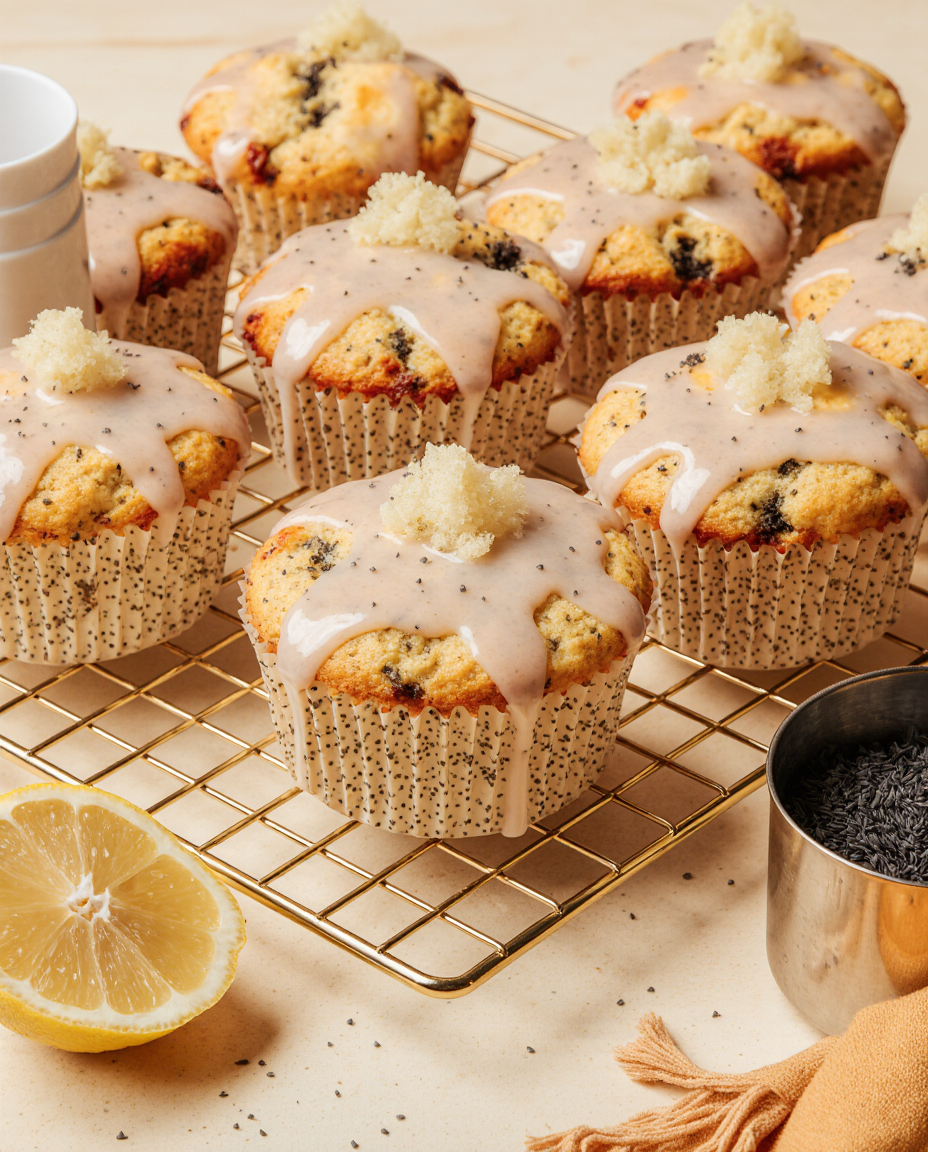
Lemon Poppy Seed Muffins with Quick Lemon Glaze
These lemon poppy seed muffins focus on clean citrus flavor, a tender crumb that stays soft after cooling, and a thin lemon glaze that sets instead of soaking in. The ratios below balance fat and acidity so the lemon reads bright without tasting sharp, and the batter stays easy to mix by hand. The method covers mixing order, a short rest that improves crumb, and heat management so the centers finish without dry edges. Cups and tablespoons only.
Why this recipe works
Acid–fat balance: Lemon juice and zest need support from fat to taste rounded, not sour. Melted butter and a modest amount of sour cream supply fat and emulsifiers that carry the citrus and soften crumb without making the batter heavy.
Two leaveners, different jobs: Baking powder provides the main rise; a small amount of baking soda neutralizes part of the lemon’s acidity, improving browning and crumb tenderness. Too much soda leads to soapy flavors; too little and the muffins eat dense. This split is tuned for even interior structure.
Short rest window: A brief 5–10 minute stand lets the flour hydrate and the leaveners begin to work. The batter thickens slightly, which helps structure. Long rests drain lift in the bowl; this window is the sweet spot.
Heat plan: Starting the bake hotter sets exterior structure, then dropping the temperature finishes the centers without overbrowning the edges. The timing below favors even texture over color alone.
Glaze that behaves: A thin, lemon-forward glaze goes on warm muffins. The ratio here sets cleanly rather than staying tacky, so you can box or stack once dry.
Ingredients (cups & tablespoons only)
Muffin Batter
- 2 cupsall-purpose flour, spooned & leveled
- 3/4 cupgranulated sugar
- 2 tspbaking powder
- 1/2 tspbaking soda
- 3/4 tspfine salt
- 2 tbsppoppy seeds
- 2large eggs, room temperature
- 3/4 cupwhole milk
- 1/2 cupsour cream (or plain Greek yogurt)
- 1/2 cupunsalted butter, melted & cooled
- 2 tspvanilla extract
- 2 tbspfinely grated lemon zest (2 large lemons)
- 2 tbspfresh lemon juice
Lemon Glaze
- 1 cuppowdered sugar
- 2–3 tbspfresh lemon juice
- 1 tspfinely grated lemon zest
- pinchfine salt
Recipe
- Preheat: Heat oven to 400°F. Line a standard 12-cup muffin tin.
- Dry mix: In a large bowl whisk flour, sugar, baking powder, baking soda, salt, and poppy seeds until uniform.
- Wet mix: In a second bowl whisk eggs, milk, sour cream, melted butter, vanilla, lemon zest, and lemon juice until smooth.
- Combine: Pour wet over dry. Fold with a spatula just until no dry pockets remain. Batter should be thick with small lumps; do not beat smooth.
- Portion: Divide batter evenly (nearly to the top of each cup). Rest the filled pan 5–8 minutes on the counter.
- Bake: Bake 8 minutes at 400°F. Without opening the door long, reduce to 350°F and bake 9–11 minutes more until a tester at the edge shows moist crumbs.
- Cool & glaze: Cool 10 minutes in pan, then transfer to a rack. Whisk glaze to thin-ribbon consistency and spoon over warm muffins. Let set 10–15 minutes.
Judge doneness by texture cues, not color alone; citrus batters can brown lightly while finishing inside.
Technique & cues
Mixing order
Combine all dry ingredients first to distribute leaveners. Whisk all wet ingredients until fully blended. Folding wet into dry limits gluten development for a softer crumb.
Short rest
Letting portioned batter sit a few minutes hydrates flour and thickens the mix. That steadies structure and keeps the interior uniform after baking.
Heat management
Start warmer to set edges, finish cooler to cook through gently. If muffins brown too quickly, reduce the initial phase by a minute on your oven.
Butter must be melted then cooled until barely warm. Too hot and it tightens the batter or curdles the dairy. Sour cream adds body and moisture; if using Greek yogurt, choose full-fat and thin the batter with 1–2 teaspoons milk only if needed for flow.
Glaze details
Target a thin, pourable glaze that falls in ribbons and disappears within 5–7 seconds. If it piles up, add a few drops of lemon juice. If it runs like water, mix in a teaspoon of powdered sugar. Spoon over warm—not hot—muffins so it sets instead of soaking.
Flavor options
- Vanilla–lemon: Add 1/2 teaspoon vanilla to glaze for a softer citrus profile.
- Almond–lemon: Add 1/4 teaspoon pure almond extract to the batter; keep the glaze lemon-only.
Common mistakes (and fixes)
- Dry, bready crumb: Overmixed. Next time fold just to hydrate; switch to full-fat sour cream; pull a minute earlier.
- Wet or gummy center: Underbaked or portion too large. Extend finish at 350°F by 2–3 minutes; confirm with a tester at the edge, not the center pocket.
- Harsh lemon flavor: Too much juice or pith in the zest. Measure juice; zest lightly without digging into the white pith.
- Greasy bottoms: Over-greased pan or muffins left in pan too long. Lightly grease or use liners; move to a rack after 10 minutes.
- Tough top skin: Oven too low in the first phase or batter overworked. Keep the initial 400°F phase and avoid beating smooth.
Substitutions & variations
Sour cream / yogurt
- Greek yogurt swaps 1:1. If batter gets too stiff, add 1–2 tsp milk.
- Buttermilk: replace milk with buttermilk; add 1–2 tsp extra sugar to balance acidity.
Lime or orange
- Lime: same amounts; flavor is sharper—keep glaze lemon or lime to match.
- Orange: use 3 tbsp zest, 2 tbsp juice; glaze with orange juice plus a pinch of salt.
Texture tweaks
- Chia: replace 1 tbsp poppy seeds with 1 tbsp chia for a softer bite.
- Blueberries: fold 3/4 cup fresh berries gently; extend bake 1–2 minutes.
Keep it tender
- Use almond or oat milk; replace butter with neutral oil (same volume).
- Add 1 extra tablespoon sugar to compensate for flavor loss from butter.
1:1 blends
- Use a 1:1 gluten-free flour that includes xanthan.
- Rest portioned batter 10–12 minutes before baking for best structure.
Slight reduction
- Drop granulated sugar to 2/3 cup; keep glaze as written to finish flavor.
Any change alters moisture and sweetness. Keep batter thickness similar to preserve texture and rise.
Altitude & scaling
High altitude (3,500–6,000 ft)
- Decrease baking powder to 1 3/4 tsp; keep soda at 1/2 tsp.
- Increase milk by 1–2 tsp if batter looks stiff.
- Start checking doneness 1–2 minutes earlier.
Half batch (6 muffins)
- Flour 1 cup; Sugar 6 tbsp
- Baking powder 1 tsp; Soda 1/4 tsp; Salt 1/3 tsp
- Poppy seeds 1 tbsp; Eggs 1
- Milk 6 tbsp; Sour cream 1/4 cup
- Butter 1/4 cup; Vanilla 1 tsp
- Zest 1 tbsp; Lemon juice 1 tbsp
Double batch (24 muffins)
Double everything exactly. Use two pans on the center rack and rotate front-to-back at the temperature drop.
Nutrition (estimated)
| Nutrient | Amount |
|---|---|
| Calories | ~290 kcal |
| Total Fat | 12 g |
| Saturated Fat | 7 g |
| Carbohydrates | 41 g |
| Total Sugars | 24 g |
| Fiber | 1 g |
| Protein | 4 g |
| Sodium | ~260 mg |
| Serving Size | 1 muffin (with glaze) |
Values are estimates from standard databases. Actual numbers vary by brands, citrus size, and glaze amount used.
Storage & freezing
- Room temp: Airtight up to 2 days. Vent the container slightly for the first hour to avoid condensation under the glaze.
- Fridge: Up to 5 days; bring to room temperature for best texture.
- Freeze: Unglazed muffins freeze best. Wrap and freeze up to 2 months. Thaw at room temp; glaze after thawing.
- Refresh: If stored, warm 5 minutes at 300°F to soften crumb before serving.
FAQ
Can I skip the sour cream?
Use plain Greek yogurt instead; if the batter tightens, loosen with 1–2 teaspoons milk.
Why start hot then reduce?
The warmer phase sets exterior structure quickly so the muffins keep their shape while the interior finishes more gently at 350°F.
Can I bake without liners?
Yes. Lightly grease the cups and cool in the pan only 10 minutes to prevent steam from softening edges.
How strong is the lemon flavor?
Balanced. For more intensity, add 1 extra teaspoon zest and finish with a slightly thinner glaze.
Can I make the batter ahead?
Not recommended. Mix dry and wet separately, combine just before baking, then rest 5–8 minutes after portioning.
Cook notes
- Zest finely. Coarse strips can taste bitter and disrupt texture.
- Measure flour correctly. Spoon and level; packed cups lead to a dry crumb.
- Fold, don’t beat. Stop as soon as dry spots disappear. Small lumps are fine.
- Check near the edge. A tester dead-center can hit a pocket and mislead; check 1/3 in from the rim.
- Glaze timing. Warm muffins take glaze well and set quickly; very hot muffins make it run, cold muffins prevent adhesion.